Work continues

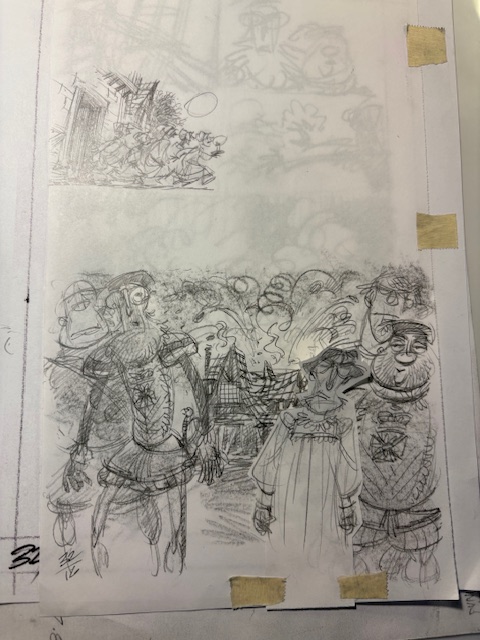
I may have mentioned that I will be releasing Gloriana in ten 16-page installments. Each will end on kind of a cliffhanger scene. I’m wrestling with this one. The bad guys (the wizards Cornelius & Valdes) have followed Elizabeth to Kat Ashley’s school. When they don’t find her there, the bad guys burn down the building.

I don’t like this kind of scene. It’s gratuitous violence. I feel uncomfortable watching all the wanton destruction in a Mission Impossible movie, for instance. The last one I saw Tom Cruise wrecked half of Venice by driving his car into everything. I had a hard time watching Mel Gibson’s Patriot when the Brits burned down a church. So, sure, I’m a sensitive plant.

On the other hand, I need to show you that my protagonist, Elizabeth, is in grave danger. If my villains don’t do awful things, they’ll be mere comic relief.

Here is the sketch of Cornelius & Valdes and their henchmen walking away from the burning school.
Les Matelots

French sailors, that is.

England under King Henry VIII was having a back-and-forth war with the French. He raided France, so France decided to raid England. They were trying to steal territory from each other. Back in those days land equaled wealth. The Industrial Revolution was still a few centuries away, so most trade was in agricultural goods—produce and livestock, lumber. You need land for all that.

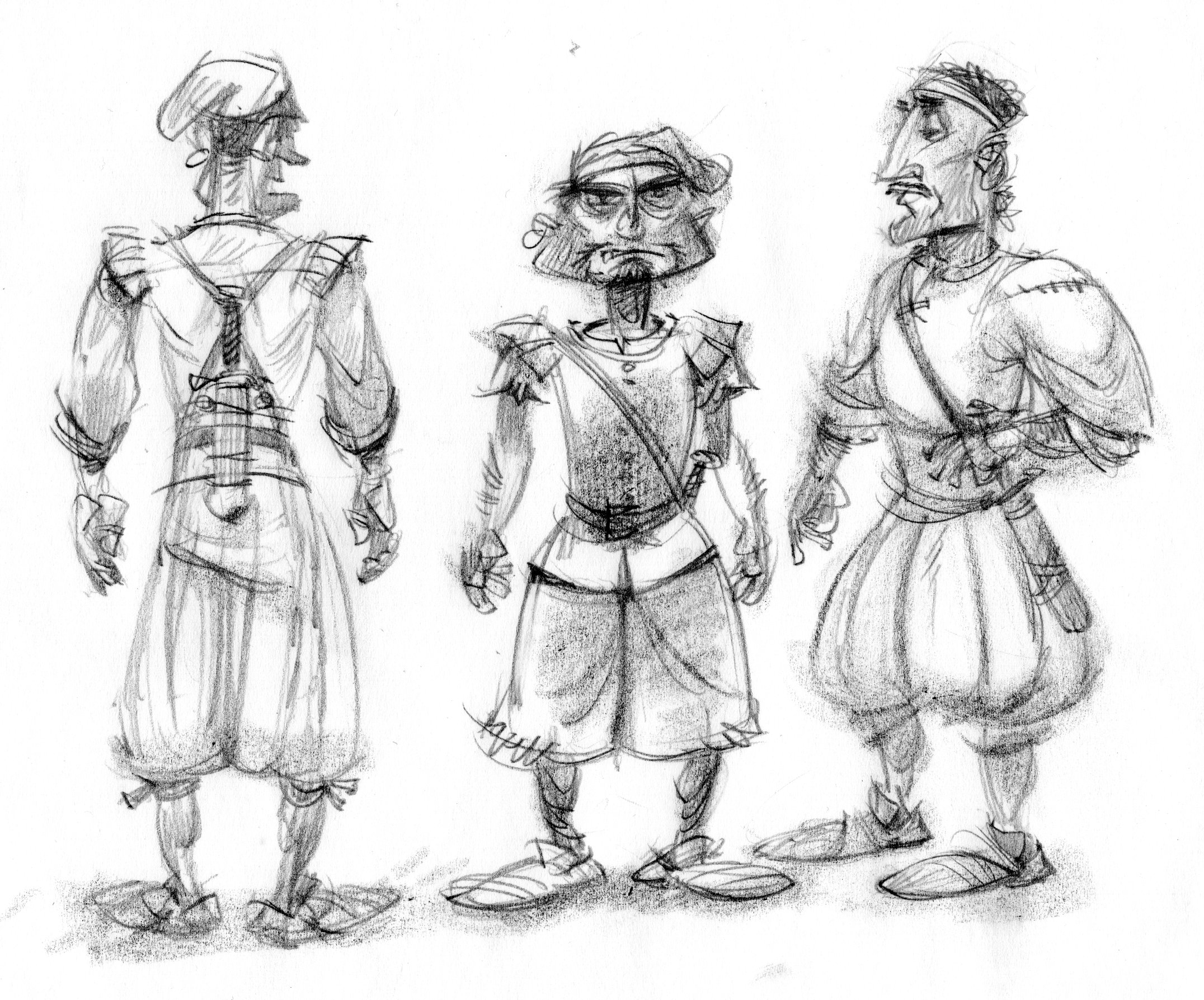
This is a pirate tale, so our heroine, Elizabeth, will run into the French navy around Page 54. Here are sketches of French sailors who serve aboard the Carraquon. In Elizabeth’s day, navies didn’t provide uniforms for their sailors. I should probably have drawn them with bare feet, as they would have been aboard ship. Many sailors wore big, wide-legged trousers called slops.

Thumbnail sketches

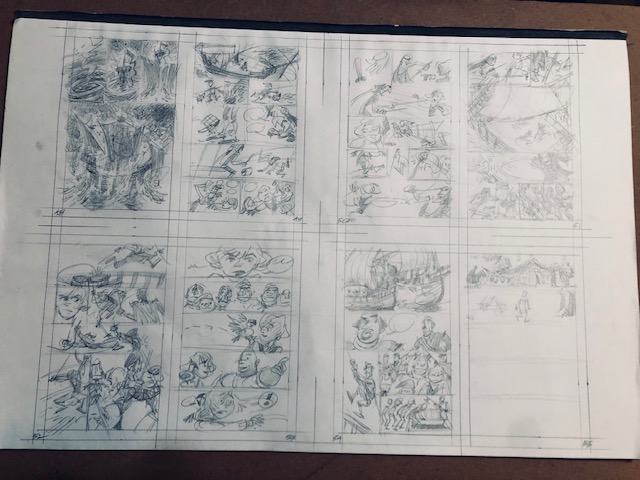
The GLORIANA manuscript is written. You’ve seen that I’ve been designing the characters (I think I got almost all of them now). The manuscript needs to turn into a graphic novel—that means lots of pictures. I need to map out how I’ll tell this story visually. So I start with thumbnail sketches. Little rough drawings—no frills, half-size—whose job is to give me a starting point for drawing the tight sketches.

W’s Office and Mistress Hapenny

A couple of loose sketches. I’m trying to create a little world here. The climax of GLORIANA will be a showdown between the English and French navies on a body of water called the Solent. Leading up to the battle, Henry VIII will receive info about the French through his Royal Intelligence service. You met Sir Thomas Wriothesley in the last post. Here’s a sketch of his office. I’m taking a lot of liberties with Sir Thomas, so out of decent respect for his memory I’m calling him simply ‘W.’

Here’s a sketch of W’s secretary, Mistress Hapenny. Her duties include managing the homing pigeons used to communicate with the service’s field agents. In Tudor days, ‘mistress’ meant ‘lady of the house.’

Thomas Wriothesley

More character design! Rough sketches for Sir Thomas Wriothesley, Lord Chancellor who runs Henry VIII’s intelligence service. When Elizabeth goes missing, Henry taps Wriothesley to find her. Wriothesley (“Call me Risley”), or Sir Thomas, or W. In real life, he dressed kind of flamboyantly (he’s sporting a leopard-print scarf in his painting—I did his caricature here. For me, I want him to look more business-like. I designed him without much reference to his portrait. The modern men’s business suit would aptly tell us about his character but of course I can’t dress him like that. Still, I want him to be dressed somberly. Also, his body type in my sketches is beefier than Wriothesley’s own. I want him to look like a boss. The American actor Ed Asner often played bosses so his body type was my starting point.

The sketch with W leaning on his desk seems a little too aggressive. W’s character is trying to run an intelligence agency staffed with at least one loose-cannon field agent. He should be a steadying figure. His character is patient and efficient in the face of chaos. The third and fourth sketches are closer to what I’m after. I think the fourth sketch is the winner.

Master Abbot character design

Here’s the pirate captain, Master Abbot. Side note: ship captains were called ‘masters’ back in those days.

The story called for a malevolent pirate captain, but this guy’s backstory took on a life of its own. Abbot became a way to point up the social upheaval of the time. He was the abbot of a monastery. That changed when King Henry VIII had a disagreement with the pope, declared the Church of England his kingdom’s new Christianity and dissolved the old Catholic monasteries. Abbot’s world was shattered. He decided to wage war on all mankind; he became a pirate.

Abbot is partially inspired by Captain Ahab who was obsessed with Moby Dick, the great white whale. Another inspiration is John Charity Spring, the demented Latin-master-turned-slave-ship-captain from the Flashman novels. I’m thinking about having Abbot speak in Latin Bible verses (King Henry replaced the vulgate Latin bibles with English ones).

I’m still fiddling with this design. He may be too skinny. I need to fix some drawing errors.

John Broadbeam

Here’s a rough sketch of a rough character—John Broadbeam, one of the pirates aboard Gloriana. He’s not a historical character; I made him up. Broadbeam will help Elizabeth escape England. I’d originally thought to cast Brian Blessed for this role. Broadbeam is a big, hearty character. As I’m drawing the storyboard, though, I realize a polyglot crew would be accurate even back in the mid-1500s. Beside that, I need a little visual variety. I can’t have all the big, hairy guys looking like Henry VIII.

So John Broadbeam is black. Should he be English-born or from North Africa?

Here’s Brian Blessed, skip to the 1:00 mark.

I don’t have a particular actor in mind for Broadbeam now. Maybe I’ll just keep drawing and get a feel for him.

Consortium boardroom sketch

As I mentioned earlier, I added to GLORIANA’s story: an evil cabal of wealthy financiers who want to take over the kingdoms of 16th -century Europe. Most of the architecture in Elizabeth’s world is Tudor-style. To differentiate the world of these bad guys, their architecture will be mediaeval Gothic. This is a sketch I did to help me visualize their world. Gothic looks heavier and more imposing than other styles.

If, like me, you’d been a student of art teacher Rolly Ivers at Cicero High School back in the 1970s, you’d have been given an introduction to architectural history. It was one of his passions. We all had 3-ring binders full of the mimeographed handouts he painstakingly assembled. I’ll always be grateful Rolly shared that with us. Because I have that foundation, I can whip out a sketch like this even before doing a bunch of research. Of course, I’ll look up Gothic interiors to amplify and fine-tune what I started here. But having a well of images in my head helps me to work efficiently.